The STEM+ Academy Model
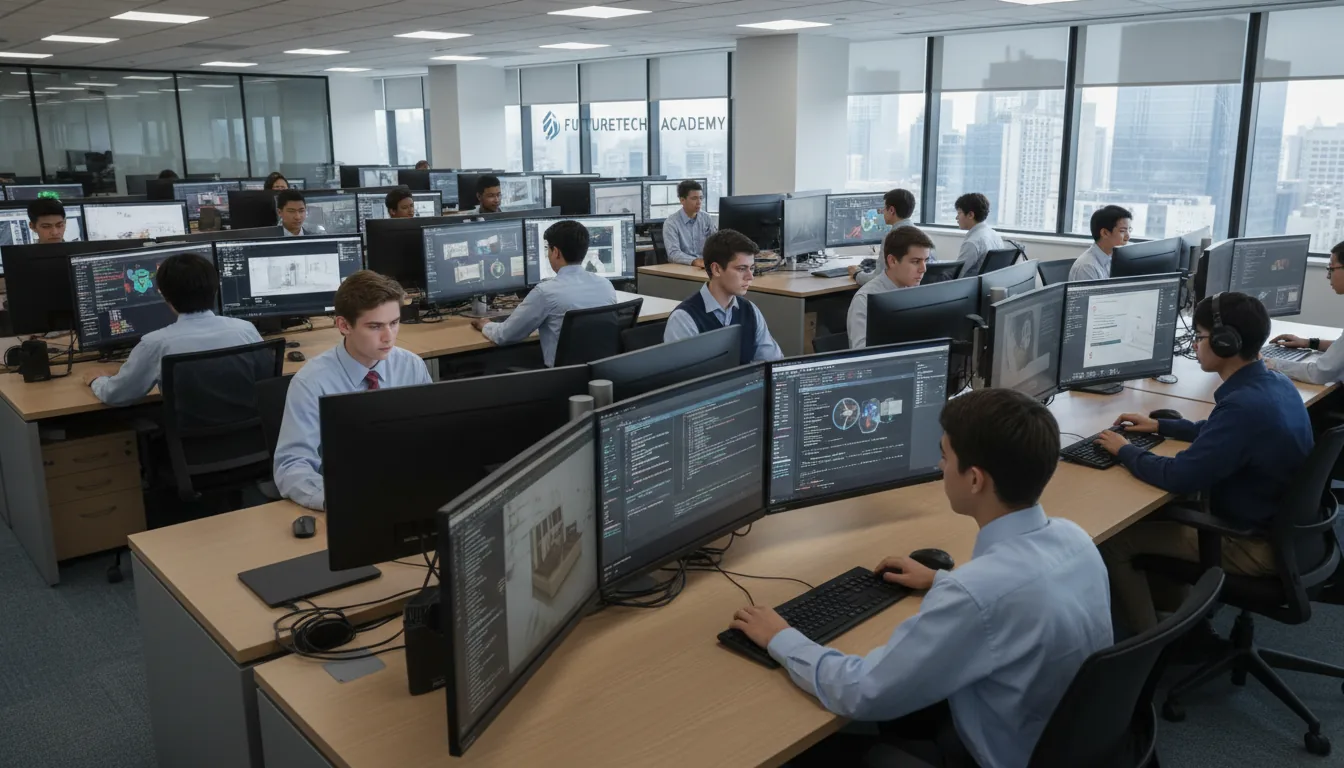
The K-12 STEM+ Academy is a structured supplemental-learning program layered on top of a school’s regular curriculum. It bundles vetted coursework, a mentoring and motivation program, teacher training, administrator reporting, and tech support into a single coordinated deployment. Academies run in after-school blocks, during summer learning, as part of credit-recovery programming, or as a pull-out enrichment model — whatever shape the district’s schedule and funding support.
Why the Academy Model Works
Academies work because they solve the two problems that usually sink supplemental programs: (1) students drop out of unstructured online coursework quickly, and (2) teachers do not have time to manually wrap curriculum with mentoring, motivation, and reporting. An academy bundles all three — content, wrap-around structure, and instrumentation — so the program runs even when district capacity is thin. Evidence from MENTOR and CASEL meta-analyses consistently ties structured mentoring and social-emotional supports to measurable gains in attendance, test scores, and graduation rates.
Curriculum Focus
Academy curriculum is typically drawn from programs reviewed favorably by the U.S. Department of Education’s What Works Clearinghouse and aligned to common state standards. The catalog spans 16 academy tracks across four grade bands:
- K-5 (2 tracks): Math and ELA (reading) foundations
- 6-8 (3 tracks): Math, ELA, and digital literacy / online safety
- 9-12 (8 tracks): Math, ELA, science, social studies, SAT / ACT prep, IT and cybersecurity, business, and management
- Vocational / CTE (3 tracks): IT, business, and management with stackable industry credentials
The “ISLMMTT” Support Wrap
Districts that run academies typically pair curriculum with a seven-part support structure, sometimes abbreviated ISLMMTT:
- Individualized instruction: placement diagnostics so every student enters at the right level
- Stipends for academy directors, lead teachers, and mentors — recognizing the real time the program takes
- LMS for tracking: progress, activity, and assessment rolled up to administrators in near-real-time
- Motivational programs: structured recognition, milestone awards, and engagement mechanics
- Mentoring: structured peer and adult mentoring that pairs academic support with relationship
- Teacher training: pacing guides, professional development, and classroom coaching
- Tech support: tiered help desk so students and teachers are not blocked by broken technology
Each of these elements is evidence-based; meta-analyses from MENTOR (structured mentoring) and CASEL (social-emotional learning) find consistent positive effects on attendance, test scores, and graduation rates across diverse school contexts.
IT, Cybersecurity, and Business Certification Tracks
Academy students can pursue industry-recognized credentials within the academy framework, including Microsoft (MOS, SC-series), Cisco (CCNA), CompTIA (A+, Network+, Security+), and business and project-management credentials at age-appropriate levels. The IC3 Digital Literacy course prepares middle-school students for state digital-literacy exams and covers Computing Fundamentals, Key Applications, and Living Online. High-school pathways can stack into dual-credit coursework that counts toward industry credentials before graduation.
Typical Program Shape
A representative first-year shape: one or two pilot schools, a specific grade-band focus (e.g., 6–8 math academy + 9–12 digital-literacy / cybersecurity / SAT-ACT prep), teacher onboarding in the first month, mid-year and year-end reporting, and a renewal conversation built around measured outcomes. This lets the district land the program with low early risk and renew with real data.
Funding
Academies are typically funded through a mix of local budget, federal Title I / Title IV Part A, E-Rate where applicable, state CTE and digital-equity funds, and CyberLearning grant programs — especially the STEM+ Grant, Digital Literacy Grant, Adopt-A-School Grant, and Teacher Training Grant. Stacking multiple funding sources is standard for multi-year academies.
Related Pages
K-12 program overview · Total Solution Services · Mentoring & Motivation · K-12 course library · U.S. school partners.
Authoritative References
- What Works Clearinghouse
- MENTOR Elements of Effective Practice
- CASEL (Social and Emotional Learning)
Start a Conversation
Districts interested in scoping an academy should contact CyberLearning for a scoping call. The call covers goals, target grade band, schedule, budget, and funding mix, and ends with a proposed academy shape you can take to your board.